 By
By Claude Code Security: AI Vulnerability Scanning for Vibe Coding
If you’ve ever shipped code quickly and told yourself you’ll “tighten security later,” you’re not alone. The problem is that “later” often arrives as an incident: a leaked key, a subtle injection path, or a logic flaw that no rule-based scanner ever flagged. Anthropic’s new Claude Code Security is an optimistic bet that we can compress that timeline, catching the kinds of bugs that usually require a patient human researcher, while still keeping developers firmly in control of what gets merged.
Released as a limited research preview on February 20, 2026, Claude Code Security is built into the web version of Claude Code and aims to do more than the usual “match patterns, produce alerts” loop. Instead, it tries to reason over an entire codebase, how data moves, where boundaries are crossed, how modules interact, and then proposes targeted fixes that humans review before anything lands in production.
Why “vibe coding” needs a security co-pilot
Vibe coding, shipping fast with AI assistance, quick iterations, and minimal ceremony, can be a productivity superpower. It also changes the risk profile. When output velocity goes up, it becomes easier to introduce edge-case failures: a missing authorization check on one endpoint, a “temporary” debug route that never gets removed, or a data flow that becomes unsafe once a seemingly unrelated refactor lands.
Traditional static application security testing (SAST) tools do catch plenty of real issues. But they tend to shine when vulnerabilities look like known patterns: obvious injection sinks, risky crypto usage, hardcoded secrets, and other signature-friendly mistakes. The ugly incidents, though, often come from subtle logic: a user-controlled value that reaches an admin-only codepath after two redirects, or a data validation function that’s correct in isolation but wrong in composition.
Anthropic’s pitch is pretty simple when you zoom out. If you can get a model to actually understand program intent and cross-file context, more like a security researcher reading code than a linter scanning tokens, you can catch a different class of vulnerabilities earlier in the lifecycle.
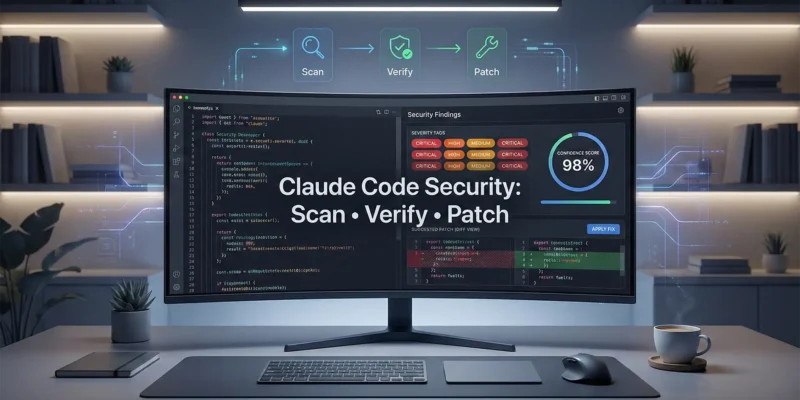
How Claude Code Security works: scan, verify, patch
Claude Code Security is built around a three-step workflow that maps cleanly onto how many security teams already operate, but with a twist: the system is designed to reduce noise before it ever hits humans.
1) Scan
In the scan phase, Claude reads the repository with a goal that’s closer to “trace what could go wrong” than “spot this regex.” Anthropic says it can follow data flows across files, reason about component interaction, and flag vulnerabilities that rule-based tools might miss. That framing matters for modern codebases where the dangerous behavior is frequently emergent, meaning the integration is the problem, not a single suspicious line.
2) Verify (adversarial self-verification)
Here’s the most distinctive design choice: before a finding reaches a person, Claude runs what Anthropic calls adversarial self-verification. In plain terms, the system challenges its own conclusion, trying to disprove the vulnerability or find reasons it might not be exploitable. The intended outcome is fewer false positives, which is not a cosmetic benefit. In many organizations, alert fatigue is the reason security findings get ignored, deferred, or permanently pushed to “we’ll do it later.”
3) Patch
Claude Code Security doesn’t stop at “here’s the issue.” It proposes a targeted patch and presents it in a dashboard along with context, prioritization, and a confidence signal. Importantly, Anthropic emphasizes that patches are not applied automatically; a human still reviews and approves changes before anything is merged. That one detail matters a lot in real teams, because auto-fixes can be tempting, but they can also introduce regressions, break workflows, or quietly change behavior in ways you only notice once production starts behaving weirdly.
The “500+ vulnerabilities” claim, and why it matters
Anthropic says its internal research, using Claude Opus 4.6, surfaced over 500 vulnerabilities in production open-source codebases, issues that had gone undetected through years of usage and review. The company also says it is handling those findings through responsible disclosure.
Even if you treat that number cautiously (and you should), it still matters for two reasons:
- It suggests a coverage gap: If reasoning-style analysis consistently finds bugs that pattern-based tools miss, teams can reduce reliance on “hope and backlog” as a security strategy.
- It points to a new role for coding models: The leap from “assistant that writes code” to “assistant that critiques and hardens code” is a workflow shift, not just a feature update.
Security practitioners will reasonably want more detail: severity breakdowns, exploitability evidence, and reproducibility. Some of that will likely emerge as disclosures progress. But the direction is pretty clear. AI systems are moving from productivity tools into the security review layer, especially for codebases that are too large, too fast-moving, or too understaffed to manually audit at the pace attackers can scan.
Dual-use reality: the same power helps attackers
Claude Code Security is not being released as “click to secure your repo” for everyone. Anthropic is explicitly treating this as a controlled research preview, and the reasoning isn’t hard to understand. The capability to identify vulnerabilities at scale can help defenders patch faster, but it can also help attackers locate weak points faster.
That’s why the rollout is limited to Enterprise and Team customers in Claude Code on the web, alongside an expedited access path for open-source maintainers. The gating isn’t just a product strategy. It’s also a safety posture, basically: slow the diffusion of a powerful capability until guardrails, policies, and workflows are battle-tested.
For vibe coding teams, this is actually reassuring. A security assistant that can propose patches is valuable, but only if it’s deployed with disciplined review practices. Keeping humans in the loop is not a limitation. It’s the operating model that makes a tool like this usable in production without creating new kinds of risk.
How this fits into real DevSecOps workflows
Anthropic is positioning Claude Code Security as something that works alongside existing security tools, not a wholesale replacement. That’s the only realistic path, because modern security programs aren’t just “find a bug and fix it.” They include policy controls, dependency scanning, secrets management, runtime detection, identity governance, incident response, and compliance reporting.
In practice, the most compelling use case is as a pre-PR and pre-release hardening layer:
- Before a big refactor ships: Run a scan to catch authorization and data flow regressions that tests might not cover.
- On high-risk surfaces: Authentication, billing, admin tools, file upload pipelines, and anything handling untrusted input.
- For “fast lanes” of development: Small teams moving quickly can get a second set of eyes without waiting for scarce AppSec reviewer time.
To evaluate whether it’s working, don’t start with vanity metrics like “number of findings.” Start with signals that correlate with real impact:
- Alert acceptance rate: What percentage of findings do developers agree are real and worth fixing?
- Time-to-fix: Does the patch suggestion shorten remediation cycles?
- Noise reduction: Does verification meaningfully reduce false positives compared to prior scanners?
- Regression prevention: Are fewer security bugs escaping into production over time?
Optimistically, the win isn’t replacing your security team. It’s letting a small security function scale its reach, turning expert attention from “triage endless alerts” into “review high-quality candidates and ship patches faster.”
So what will be the future?
Two things will determine whether Claude Code Security becomes a durable part of modern engineering rather than a flashy demo.
First: evidence from real deployments. Early users will validate (or challenge) the promise of adversarial self-verification, especially on large monorepos and messy legacy systems. Coverage from security outlets already frames it as promising but not magic, which is exactly the stance serious teams should take.
Second: how access expands and what guardrails stick. The dual-use concern doesn’t go away after the preview. If AI-assisted vulnerability discovery becomes common, defenders will need equally common AI-assisted patching, plus clear organizational policies about when AI can propose changes, what requires human sign-off, and how to document decisions for audits.
The optimistic read is that we’re watching a practical evolution: AI shifting from “help me write more code” to “help me ship safer code.” For vibe coding teams, that’s not a slowdown. It’s the route to keeping speed without quietly stacking up invisible security debt.
What this means for builders: If your team is moving fast with AI-assisted development, start treating security review as a continuous workflow, not a quarterly event. Tools like Claude Code Security point toward a future where “secure by default” is less about adding process and more about embedding high-signal reasoning into the day-to-day shipping loop.